Jenna Clark

Welcome to English! My name is Jenna Clark, and 2026-27 is my 16th year at Helena High School.
Students will find most course content for 2026-27 on Microsoft Teams, including class announcements, readings, and other resources.
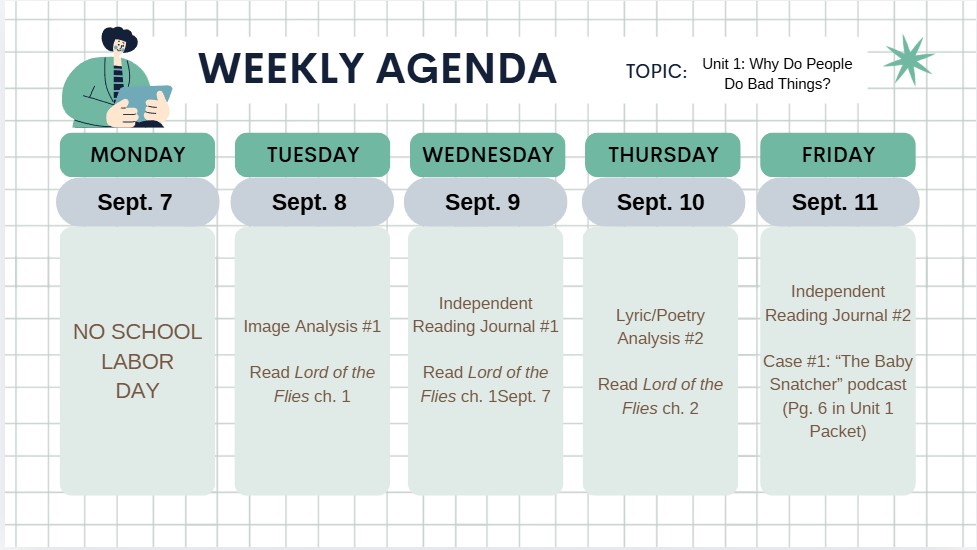
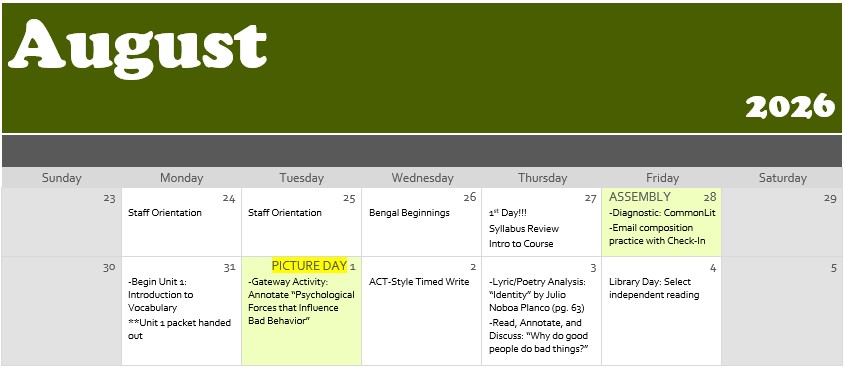
You will find my weekly agendas in the class pages (see left) as well as on the Weekly Agenda channel of our class Team.
Parents are always welcome to reach out to me via email (jclark@helenaschools.org), and students may email or use Teams Chat if they have any questions or concerns throughout the year.
What we’re working on this month…
…in English IV: World Lit.
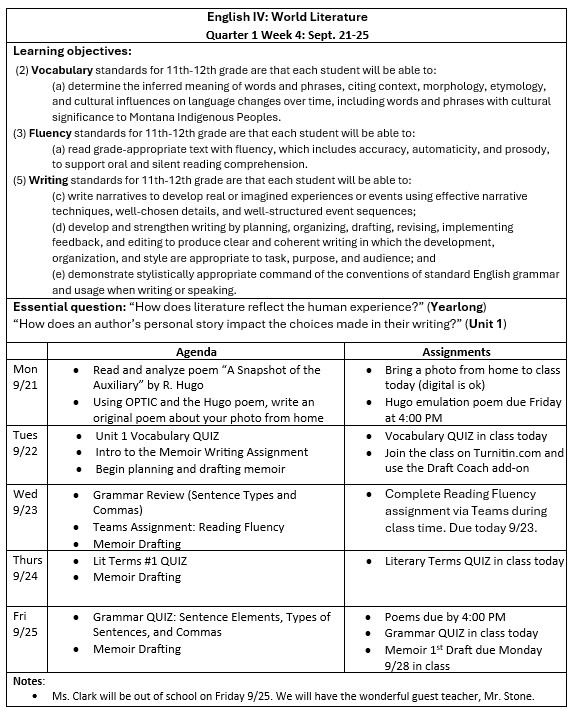
We’re starting Unit 1: Examining Self in the month of September. This will begin with establishing a few classroom routines in the first full week of school, but we’ll also begin working toward writing a short memoir at the end of the unit. This piece of personal writing is a fun way to apply narrative techniques to a non-fiction topic, and as a bonus it also works well as a springboard to college and scholarship application writing. Within this unit, we’ll learn how to analyze both text and images using memorable strategies and annotation tools. We will watch the film The Glass Castle, based on Jeanette Walls’s memoir of the same name, and read excerpts from memoirs by Michelle Zauner, Trevor Noah, and Naomi Shihab Nye, as well as brainstorming details and doing practice “quickwrites” about our own lives as we gather details in preparation for writing a memoir at the end of the unit. Families can support their English IV students during this unit by helping them to get back into school routines, and by talking to them about their lives and the ideas they’re gathering for their memoirs. On Monday 9/21, we will ask students to bring in a photograph: they will write a poem based on the structure of Richard Hugo’s “A Snapshot of the Auxiliary,” which describes a photo from the past. The photo can include any school-appropriate subject matter, but it should be something that inspires your student by sparking memories or emotions. The photo does not need to be printed on photo paper; a digital copy will work just as well.
…in AP Language.
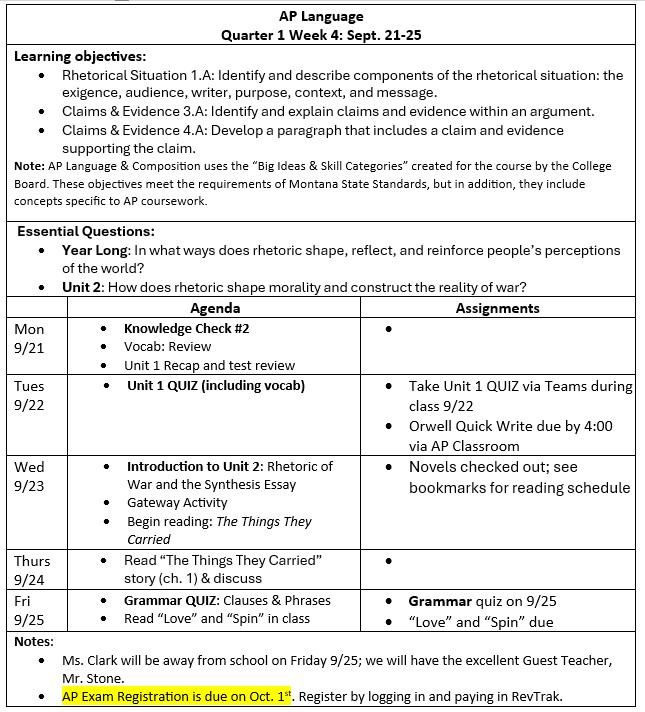
In September, AP Language students will lay important groundwork for the rest of the year by learning rhetorical terminology, establishing discussion protocols, and practicing foundational rhetorical analysis skills. Our anchor text in this first unit is George Orwell’s essay “Politics and the English Language,” which will take us several days to read, annotate, analyze, and discuss. We will also wrap up their summer reading by writing about each text and sharing a brief analysis with the class. Students will meet “SPACECAT,” our rhetorical analysis mnemonic, as well as the classical Five Canons of Rhetoric, the rhetorical triangle, and rhetorical appeals. We will also get the lay of the land in AP Classroom, the official College Board site for AP students, in which we’ll practice some multiple choices questions and explore study tools. Because this unit is pretty vocabulary-heavy, this is a great time to help your student study with flashcards. Families may also want to talk to students about what they are reading, as “book talks” will be a feature of both the summer reading assignment and our independent reading project, and asking them what they think of their reading is a great way to help them practice sharing this kind of thinking with others.
…in English II:
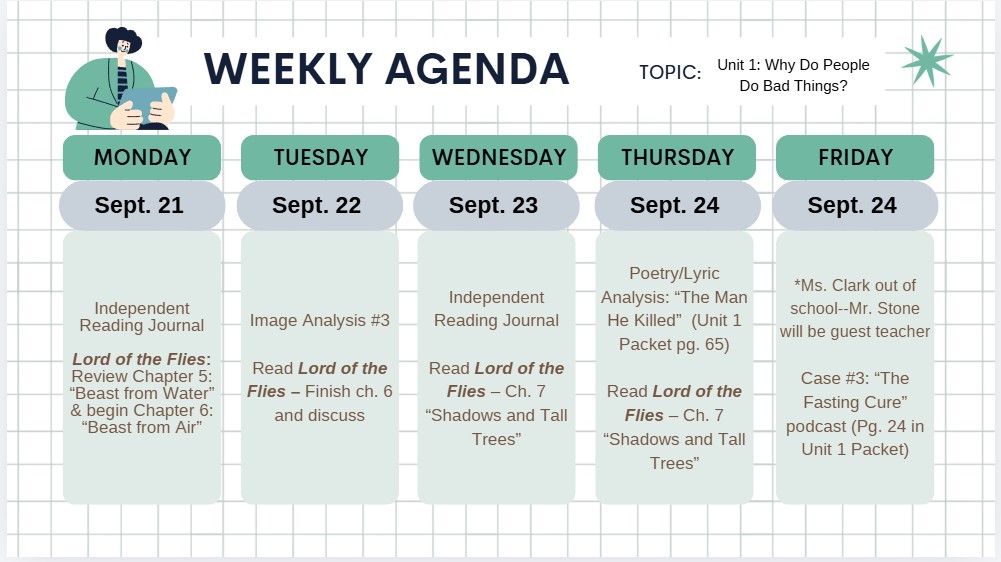
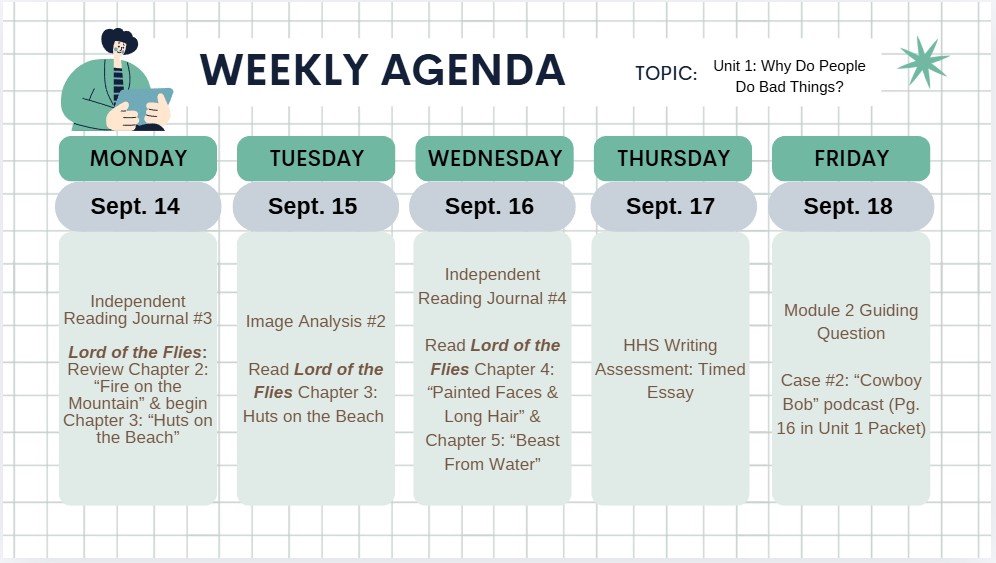
Sophomore English begins with Unit 1: What Makes People Do Bad Things? In this unit, we’ll build toward writing an argument essay by gathering evidence from a series of case studies, each in response to a guiding question about human behavior. Our anchor text for this unit is the classic William Golding novel The Lord of the Flies. We’ll also work throughout the unit on MLA citation and formatting to facilitate research projects in later units. Students in English II will benefit from support at home to track assignment due dates and ensure that work is being turned in on time. The grace periods for late work (see the course syllabus) are shorter than they were in Freshman English, and it can be easy for late work to create a snowball effect, which can become overwhelming quickly.
Please reach out to me (email: jclark@helenaschools.org) if you have any questions or concerns at any point throughout this month.
Links
-
Novel and Film Rationales
Rationales describe course texts and the reasons for their inclusion in curriculum -
English Department Webpage
Find information on HHS English and Summer Reading
Documents
-
English IV World Lit, Myth
Syllabus for English 4 World Lit and Mythology -
AP Language Syllabus
Syllabus for AP Language Clark -
English II Syllabus
Syllabus for English 2 Clark